Biblical Advice for the Internet Age

July 12, 2011

[Note: I am back. After a three month hiatus, during which travel and other obligations made it rather hard to post, I am back, and have prepared a number of interesting posts for the upcoming weeks. Thanks for hanging in and being so patient!]

In the twenty odd years since its inception, the World Wide Web has proven to be a most revolutionary innovation, enabling human cooperation on a previously unimaginable scale. At the fulcrum of this massive cooperation machine, we find the ever more ubiquitous social networks and other socially enabled sites, which enable us to exchange information and connect to each other in an unprecedented manner.

We maintain contact with friends and family, reconnect to ever more long lost classmates and colleagues, discover previously unknown relatives, and even expand our professional networks, seek jobs and recruit clients with ease, whereas as recently as fifteen years ago, we still needed to rely mainly on printed phone books and classified ads.

And yet, a malaise is setting in. Repeated stories of job applications denied after HR managers uncovered compromising personal pages, as well as repeated privacy breaches potentially exposing users to identity theft is making users more wary. Read the rest of this entry »


Audio-Vorträge: Die jüdischen Hauptereignisse des 20. Jahrhunderts

June 1, 2011

Anbei de Audio-Dateien der zwei Vorträge einer Mini-Serie zum Thema der jüdischen Hauptereignisse des 20. Jahrhunderts: “Holocaust und Entstehung des Staates Israel, Wie können wir diesen beiden Ereignissen in unseren Gebeten gerecht werden?” Die Serie wurde am 2. und 8. Mai 2011 in der Schomre Thora Basel präsentiert, und zu jedem Vortrag wurde ein (hoffentlich) passender Psalm gelernt. Read the rest of this entry »

Meditating on the Tragedy in Japan

April 11, 2011

It’s been a month since tragedy hit Japan and over 25’000 men, women and children died, many of them swept away by the terrible waves of the tsunami. 150’000 are still homeless, living in temporary shelters. Many more are probably living with friends and relatives, so that the actual number of homeless may be much higher.

While we cannot possibly make sense of out such a human tragedy, it does (or should!) evoke in us a feeling of human brotherhood, shared suffering, a tremendous sadness that so many of G”d’s creatures, each endowed — as all humans are — with a spark of G”d-likeness, were so tragically lost (cf. the aggadeta in Megilla 10b, where G”d rebukes he angels at the Splitting of the Sea of Reeds, where the Egyptian army perished, saying “My creatures are drowning in the sea …”). It also evokes in us our very own human frailty. In the words of the author of the High Holiday liturgical poem Untane Toqef, man bears resemblance to:

… the broken shard, like dry grass, a wilted bloom, a passing shadow, a disappearing cloud, the blowing wind, the whirling dust, the fleeting dream.

And despite our frailty, we, humans, are called upon to better the world, and Israel has a particular responsibility to lead by example and construct a just, loving and spiritual society.

When faced with massive but distant tragedies such as these, one must of course ask what it is one wants to achieve.

What such a situation calls for, is, first and foremost, an emotional study of those who were facing their deaths, and of those who, while they survived, saw their homes and often their friends and relatives, too, swept away under the terrible waves. Beyond that, the sought after texts should give strength to those who survived but became bereft and destitute, and should allow those far away to explore the religious questions and needs of the survivors.

So what texts may be fitting meditations on those themes of human frailty? Which texts may give us strength in the face of the fear of death? I want to suggest the following psalms. Read the rest of this entry »


Ode an das Pessachfest und den Frühling

April 10, 2011

Von Rabbiner S.R. Hirsch, Aus der Mappe eines wandernden Juden:

Wie konnten Sie glauben, lieber N., Ihr Brief würde mich noch in meinen vier Pfählen finden; „der Winter ist vorüber, die Blüten zeigen sich, die Sangeszeit ist da“, und Ihren … duldet es zu Hause? Nein, mein Lieber. Schon als Knabe beneidete ich die Ahnen, wenn mir der Vater sie am Sederabend die Sandalen an den Füßen, die Lenden gegürtet, die Wanderstäbe in den Händen, die Brotbündel auf der Schulter vorführte, und das süßeste Charoßeth hätte ich für einen Trunk Bitterwasser hingegeben, hätte ich vierzig Jahre so mit ihnen im Freien, in der frischen Luft der Wüste wandern können! Glaube ich doch fast, Ihr Stubenhocker alle werdet noch einst dort oben für euer Hocken in der Stube zu büßen haben, und wenn Ihr zum Anschauen der Herrlichkeiten des Himmels Einlaß begehret, wird man Euch fragen: habt Ihr die Gottesherrlichkeiten auf Erden geschaut? Beschämt werdet Ihr dann stammeln: das haben wir versäumt!

Read the rest of this entry »


Denkmal an die deportierten lörracher Juden

April 8, 2011

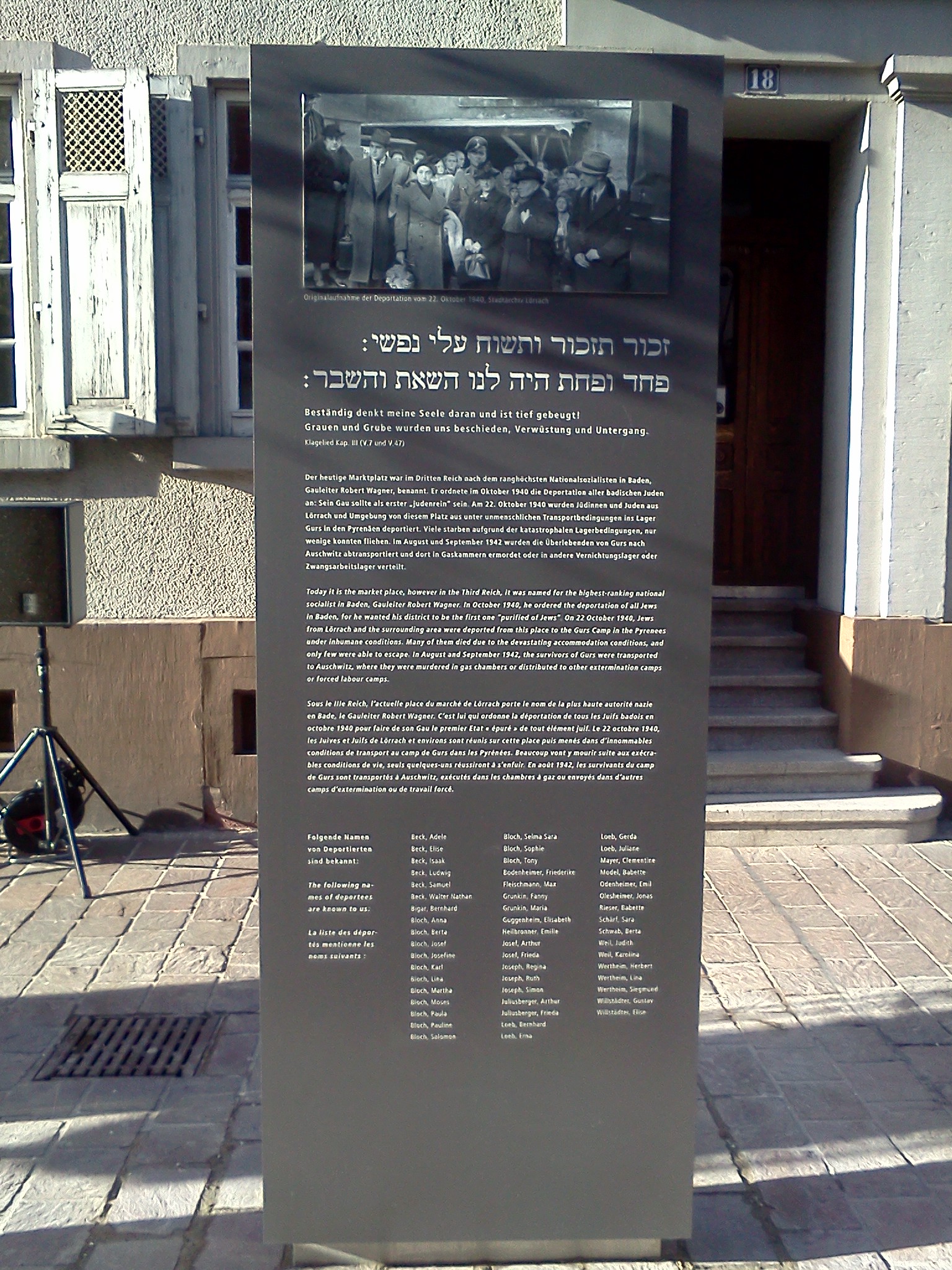
Lörracher Denkmal an den deportierten JudenAm 22. Oktober 1940, also vor etwa mehr als 70 Jahren, wurden die lörracher Juden von den Nazis und ihren Anhängern nach Gurs deportiert; Lörrach wurde Judenrein. Dieses Jahr, 2010-2011, wird in Baden-Würtemberg die Erinnerung an die Opfer besonders gross geschrieben. Damals, vor 70 Jahren, wurden nähmlich alle Juden aus dem ganzen Gau Baden nach Gurs deportiert, wo vielen in den schrecklichen Umständen starben, und von wo viele andere in den Ermordungslager verschickt wurden. Wenigen kamen zurück. Read the rest of this entry »


Holiday Art

April 4, 2011

The image left is on the 1892 edition of the Rödelheim Machsor, the well known German Jewish holiday prayerbook. It seems to represent the holidays, and I can make out most items. In the center are the Tablets of the Law, for the holiday of Shavu’ot. At the bottom, we find an incense burner in front of a shofar, representing Yom Kippur and Rosh haShana, respectively. The shofar doubles as a stringed instrument, representing the Levitical chants in the Temple. Left, above the shofar, is part of a trumpet, again evoking the Levitical musical performances during the Temple service. To the right and left are myrtle and date palm branches, two of the four species held during the Sukkot services.

However, I am mystified by the other four symbols. On top is the sun, which I am not sure what it is doing here; is it an allusion to Pessach, which always falls out in the early spring? Is it actually a radiating matza, rather than a sun? Immediately to the right of the Tablets of the Law is a structure that could be a building with lots of windows, a box for sorting little items like nails, spices, or whatever, or it could be a book with a very peculiar cover; I don’t know. On the immediate upper left of the Tablets is a kind of tube, which I cannot make sense of, either. Finally, on the left side, there seems to be a kind of chain or arc connecting the trumpet, the shofar or the myrtle branch to the sun, which I can’t interpret, either. Do you have a suggestion? If so, please leave a comment.


Will the Judge of the Entire World Not Do Justice?

April 1, 2011

I tried to avoid this issue as it was propping up in conversations and in private chain emails, in the hope that sober minds would prevail and this opinion would die down, but I was wrong, and this philosophy has now hit the media. What I am talking about is the attempt of some opinion leaders to explain the Japanese triple disaster by linking it to a particular wrong the Japanese are accused of: the conviction of three young Jewish men for unknowingly smuggling a large amount of drugs into Japan.

Rabbi David Twersky, the leader of the Rachmastrivka Hasidic dynasty, says the recent tsunami in Japan, which has left thousands of people dead, was the result of the arrest of two yeshiva students by Japanese authorities after being convicted of smuggling drugs, YNET reports. In truth, I am loath to respond, because the Rachmastrivka Rebbe is a great, G”d-fearing, holy man, infinitely more learned than I am. It is thus with quite some trepidation I write these words, but, I believe that we must write them. The notion that about 27000 people lost their lives because three Jewish men were too harshly punished, is so disproportional, that no response would be needed. However, I feel that when the internet is obscured by such incomprehensible statements, it behooves us to seek what the Torah really has to say about these matters. Read the rest of this entry »


When Theodicy Is No Theodicy

April 1, 2011

There is an old, venerable strain in Jewish thought, which would have us allow current events to inspire us to greater introspection and inspiration in our service of G”d. The question being answered is not “Why has G”d allowed such a thing to happen,” but ” how should I change my life, now that these terrible tidings have reached my ears – how to I shake myself awake to become a better person?”

To understand that approach, we should delve a little further into this citation of “the world was created for me.”* Read the rest of this entry »


Bi-Religious Eucation, or: How to Teach No Faith At All

March 28, 2011

Prof. Alan Brill has a post up on his blog about a Bi-religious afterschool program, teaching both Judaism and Christianity, presumably to the children of interfaith families. It is a project of the Trinity day school, a Christian school, at least half of whose students reportedly have at least one Jewish parent. The program self-describes itself with, among others, the following statement:

In 2010, a two-year class for teenagers was launched in the Westchester and Orange/Rockland chapters that caters to children from 12 to 14 years old. It helps them grapple with identity questions specific to that age, regarding who they are and who they want to become. The program educators, however, stress that no decision needs to be made, that identity is something that builds over time and that it can change at any time.

While the program may be very convenient for interfaith parents, who cannot make up their mind regarding faith, it is my contention that such a program cannot instill faith, any faith, Read the rest of this entry »


Homosexuals, Tolerance, the Apple App Store, and Freedom of Speech

March 24, 2011

Mobile phone “app stores” have become the new sociocultural battlegrounds. Apple, which owns and operates its iTunes application and media stores, maintains relatively tight guidelines as to what may or may not be sold through their platform. Recently, they banned an application that purported to help homosexuals become heterosexual, through what is known as reparative therapy.

Without taking any particular stand on reparative therapy (about which I should share some ramblings in the future), I found the following comment on a technology web site [slashdot.org], which strongly leans left socially, very much on the mark:

Thanks for injecting some rationality here. This is the thing I can’t understand: if someone wants to change their gender, that’s something that’s seen as acceptable, even if a bit unusual. If someone wants to change their sexual orientation, it’s presumed that someone with an agenda must have brainwashed that person and the community that shares their (original) orientation takes offence. No-one should be pushing this sort of thing on anybody, but I can’t understand why it’s an issue for such software to exist.

Read the rest of this entry »